The short answer
- Open the JSON Formatter, paste the first file, set the indentation to two spaces, and tick Sort the keys of every object. Copy the result.
- Open the Text Diff and paste it into the left-hand box.
- Do the same with the second file, into the right-hand box.
What lights up now is real: a value that changed, a key that appeared, an entry that went. The formatting differences and the reordered keys that would have drowned an ordinary diff are gone, because both sides were spelled the same way before the comparison started.
Neither page has any network feature at all — worth knowing, since the JSON people compare is so often config files with credentials still inside.
Why a raw JSON diff is mostly noise
JSON does not care about whitespace, and it does not give key order a meaning. The same document can be one line or four hundred, keys in the order they were typed or the order some library emitted them — and tools rewrite both freely. One side minified, one side pretty; one side saved by hand, the other by a serialiser that sorts alphabetically: a line diff sees two unrelated files.
The two worst cases make the point. A minified file is one line, so a diff against it is one giant changed line — true and useless. And two files with the same content in a different order diff as everything-changed, when the honest answer is “nothing”.
What the formatter's canonical form fixes
Running both files through the same formatter with the same settings is what a diff needs: one spelling per document.
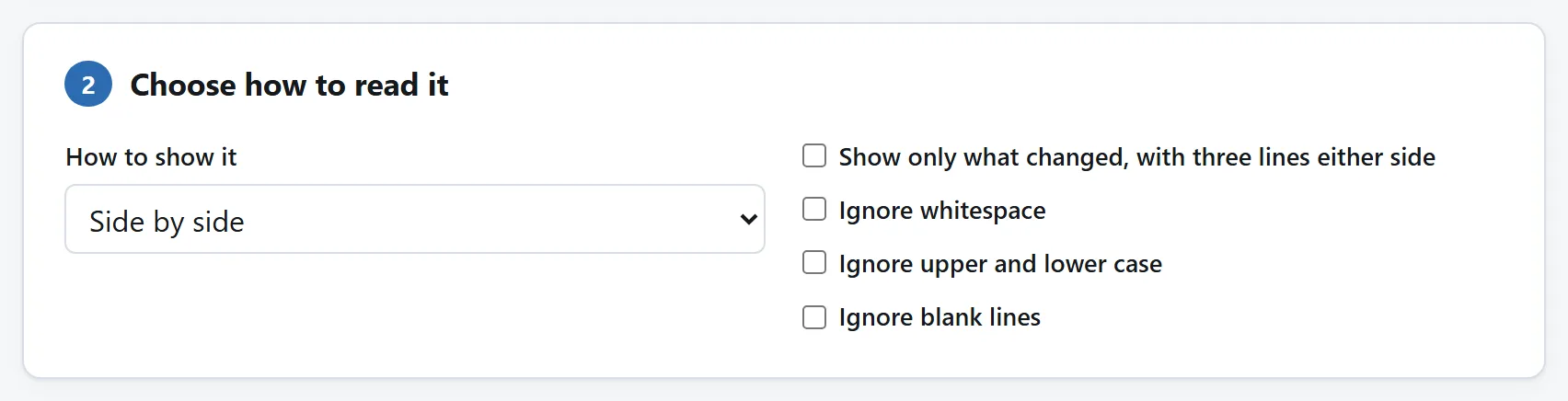
- Same indentation puts each key on its own line, so the diff works line by line, and its word-level marks can point at the one value that changed inside a line.
- Sorted keys puts both sides in the same order, so order stops being a difference. The sort is by how keys read, not by code points —
item2beforeitem10— and it is applied identically to both sides. - Nothing else moves. This formatter keeps numbers as the digits you wrote and keeps duplicate keys rather than resolving them — so canonicalising cannot itself invent a difference. The formatter guide explains why that is rarer than it should be.
One honest caveat: sorted output is the document with its keys moved. If a downstream tool cares about key order — few do, but they exist — treat the sorted copies as the things being compared, not as replacements for the originals.
Reading the result, and taking it with you
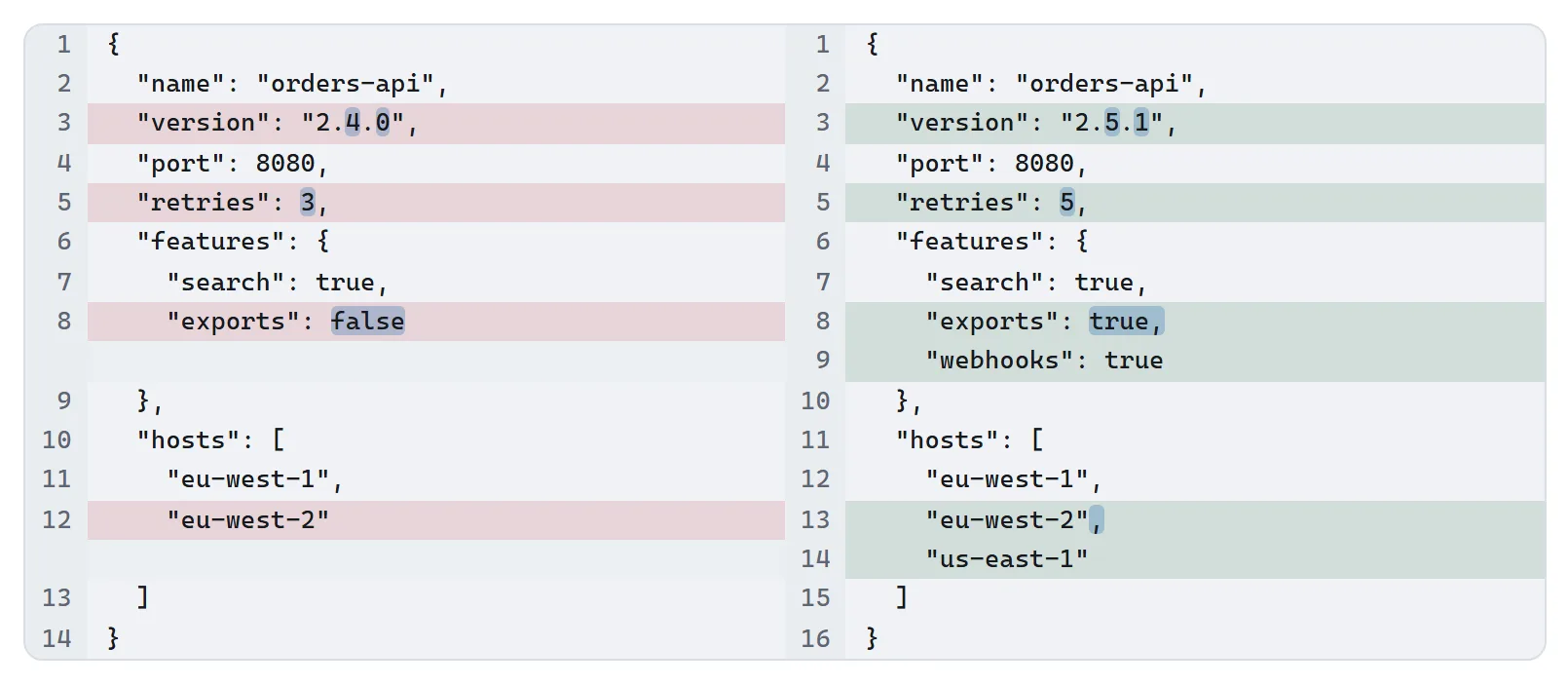
The diff marks removed lines on the left, added lines on the right, and highlights the words that changed inside a changed line — on a canonical form, that is typically the single value that moved from false to true. The unchanged middle folds to a count, so a two-thousand-line config with three edits reads as three short passages.
The download is a unified .patch — the format code review understands. It describes the canonical forms, which is usually what a review wants anyway: the change, without the reformatting.
The same recipe works for anything else both pages speak. YAML and XML canonicalise the same way; and for two files of the same shape from different sources, the diff's ignore switches — whitespace, case, blank lines — are a lighter version of the same idea.
If you do this every week
Format twice, paste twice — the steps live on two pages because each page does one job, and each can prove on its own that nothing you pasted went anywhere. But both are open source: MIT-licensed, dependency-free ES modules — the formatter's parser keeps key order and digits, the diff is Myers' algorithm — each with a README that explains it.
If this is part of your day, point a coding agent at the repository and ask it for a two-box page that canonicalises as it compares — parseJson, printJson and compareText are three imports away. The modules were written to be read, and lifting them is what the licence is for.